LED Light Therapy vs. Microneedling for Collagen
Read the guide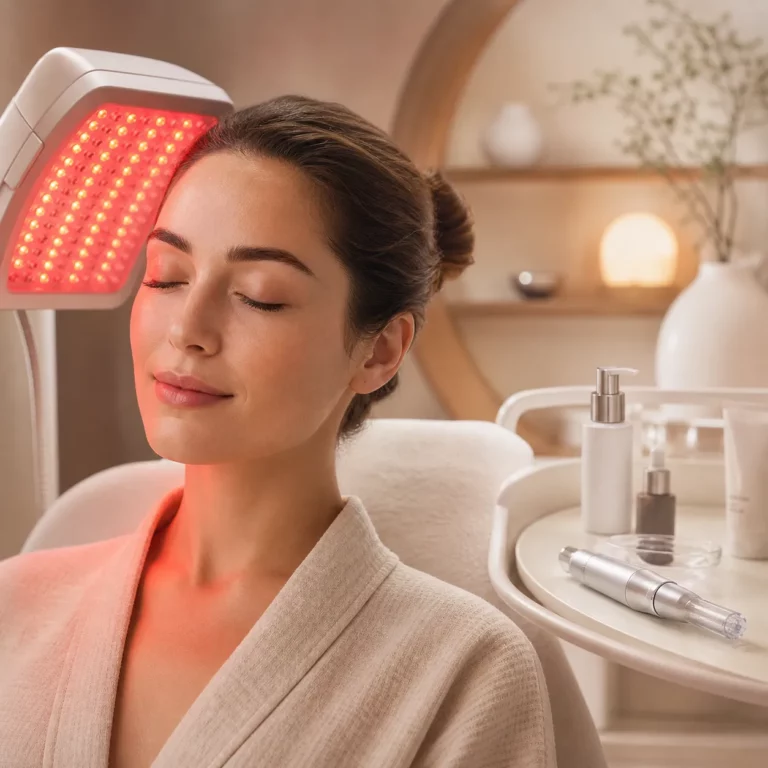

In this guide
When it comes to boosting collagen, both LED light therapy and microneedling offer effective options, but they work in very different ways. LED light therapy uses specific wavelengths of light to energize your skin cells and encourage collagen production without causing damage or downtime. Microneedling, on the other hand, creates tiny, controlled injuries in the skin to trigger your body’s natural healing process and stimulate collagen from within.
Choosing between these treatments depends on your skin type, sensitivity, and goals. At Calista Aesthetics in Santa Ana, we take a natural-first approach to skin rejuvenation, helping you decide which option – or combination – fits your needs. This guide will walk you through how each treatment works, what to expect, and which might be right for you.
LED (light-emitting diode) therapy is a gentle, non-invasive treatment that uses specific wavelengths of light to refresh and energize your skin [7]. It works by stimulating skin cells without causing any damage, making it a safe option with no downtime required [3].
Red light therapy, in particular, operates at wavelengths between 630–660 nm, which allows it to penetrate the deeper layers of the skin, known as the dermis. This is where fibroblasts – cells responsible for producing collagen and elastin – are located. Interestingly, this technology was originally researched by NASA in the 1990s to help astronauts heal wounds in space. Since then, red light therapy has been supported by Grade 1A medical evidence for its ability to encourage collagen and elastin production [7][8]. Let’s take a closer look at how it works.
Red light therapy relies on a process called photobiomodulation, where light energy is absorbed by skin cells and converted into usable energy [6]. Specifically, red light activates cytochrome C oxidase in the mitochondria, which releases nitric oxide and increases ATP (adenosine triphosphate) production [8].
This energy boost gives fibroblasts the fuel they need to produce more collagen and elastin. As a result, red light therapy can help smooth fine lines, improve skin texture, and restore firmness. Dr. Cameron Chesnut, a facial plastic surgeon, explains:
Red light at 630 to 660 nm stimulates fibroblasts to produce more collagen through the cytochrome C oxidase mechanism in the mitochondria [8].
Additionally, red light helps dilate blood vessels, improving oxygen and nutrient delivery to the skin [6].
LED light therapy offers several standout benefits. One of the most appealing is that it’s completely painless and requires no downtime. You can fit a session into your lunch break and return to your day without worrying about redness, peeling, or recovery time [7]. Unlike treatments that use ultraviolet (UV) light or heat, LED therapy is safe for all skin types, including sensitive or redness-prone skin [7][9].
With consistent use, you may start to see results within 4 to 6 weeks, and the improvements can last for months after completing a treatment series [8]. However, regularity is important – sessions should ideally be done daily or at least three times a week to maintain the benefits [4]. At Calista Aesthetics, we often recommend LED light therapy as a gentle yet effective way to support collagen production, especially for those who prefer a no-downtime approach to skin rejuvenation.
Microneedling, also called Collagen Induction Therapy (CIT), is a treatment designed to boost collagen production by creating controlled micro-injuries in the skin. Unlike energy-based treatments like LED light therapy, microneedling directly triggers your skin’s natural healing response. This process encourages the production of collagen and elastin, essential proteins for firm, smooth skin.
Using fine needles, professional microneedling devices can target different depths, ranging from 0.5 mm for fine lines to 3.0 mm for deeper scars and structural concerns. This versatility allows it to address a variety of skin issues. Additionally, microneedling creates tiny channels in the skin, enhancing the absorption of topical serums like Vitamin C or hyaluronic acid, which can amplify results. Let’s take a closer look at how this treatment works to rejuvenate your skin.
Microneedling relies on your skin’s natural wound-healing process, which occurs in three stages:
Inflammation phase: The immune system responds to the micro-injuries by cleaning the area and increasing blood flow.
Proliferation phase: Skin cells form a temporary matrix to support new collagen production.
Remodeling phase: This temporary structure is replaced with stronger Type I collagen and elastin, which help tighten and strengthen the skin.
This process activates fibroblasts, the cells responsible for producing collagen and elastin, to rebuild your skin’s support structure. The collagen produced, particularly Type III collagen, can remain active for 5 to 7 years, making microneedling a long-term solution for improving skin quality.
Microneedling offers several benefits by targeting structural skin concerns:
Improves the appearance of acne scars, deep wrinkles, and enlarged pores
Enhances skin firmness and reduces laxity
Suitable for darker skin tones (Fitzpatrick types V–VI) with minimal risk of pigmentation changes, as it doesn’t involve heat
Results typically begin to appear within 6 to 8 weeks, with the most noticeable improvements occurring between 3 to 6 months as new collagen develops. For the best outcomes, most patients undergo 3 to 6 sessions spaced 4 to 6 weeks apart. Downtime is minimal, with mild redness and swelling lasting 1 to 3 days. However, it’s best to avoid scheduling treatments right before important events.
At Calista Aesthetics, we recommend microneedling for individuals looking to improve skin texture and firmness with a treatment that prioritizes natural-looking, long-lasting results.
Both LED light therapy and microneedling encourage collagen production, but they achieve this through completely different mechanisms. Microneedling involves creating tiny, controlled injuries in the skin to activate its natural healing process. On the other hand, LED light therapy uses specific wavelengths of light to energize skin cells without causing any damage. The light is absorbed by cytochrome C oxidase in your mitochondria, which boosts ATP production – a key energy source for collagen creation.
Microneedling works by puncturing the skin at precise depths (ranging from 0.5 to 3.0 mm). This process triggers a wound-healing response, replacing temporary collagen with stronger Type I collagen and elastin. Over time, this can lead to a 400% increase in collagen and elastin production within six months of completing a four-session series.
In contrast, LED light therapy focuses on energizing your cells from the inside out. As Bill Wiedemann from Lumara explains:
Red light therapy doesn’t break the skin. It energizes it… That extra cellular energy speeds up healing, improves circulation, and supports collagen production without inflammation [3].
Because these treatments rely on entirely different processes, they also come with unique recovery experiences.
LED light therapy is completely non-invasive, so there’s no downtime. You can go back to your daily routine immediately following a session [2][3]. Microneedling, however, may cause mild redness and swelling for 1 to 3 days. For professional treatments, recovery can extend to 3–5 days due to increased skin sensitivity and redness [5]. Interestingly, combining LED light therapy 24–48 hours after microneedling can help reduce redness and speed up healing [11].
Microneedling is an excellent option for addressing deeper skin concerns, such as atrophic acne scars, pronounced wrinkles, enlarged pores, or skin laxity. Studies show a 60–70% improvement in acne scars after completing four to six sessions [7].
LED light therapy, on the other hand, is ideal for those with sensitive or redness-prone skin and for managing active acne. It helps reduce C. acnes bacteria and calms inflammation without risking infection spread. It’s also a great choice for maintaining overall skin health without any discomfort or downtime.
At Calista Aesthetics, we customize every treatment plan to suit your skin’s unique needs. During your consultation, we’ll help you decide whether microneedling, LED light therapy, or a combination of both is the best approach to meet your goals.
When exploring treatment options, understanding pricing and how plans are tailored to your needs is just as important as learning about the benefits and recovery process. At Calista Aesthetics, we’re upfront about costs and work with you to create a plan that aligns with your goals and budget. You’ll always know the total cost before starting any treatment. [12]
Your journey begins with a personalized consultation where we’ll discuss your skin concerns, health history, and timeline. Whether you’re considering microneedling, LED light therapy, or a combination of both, we’ll help you choose the approach that makes the most sense for you. [13]
Microneedling at Calista is priced at $800 per session and includes Rejuran Masks to aid in recovery. For those planning multiple treatments, we offer a 3-session package for $2,100, which reflects the typical treatment series most patients complete. Many start with three sessions spaced 4–6 weeks apart, though we adjust based on how your skin responds. [13]
Since microneedling works by stimulating your skin’s natural collagen production, improvements often appear gradually over three to six months as new Type I collagen and elastin develop. [12]
At Calista, LED light therapy is an add-on within our collagen support plans. It’s not offered as a standalone treatment but is designed to enhance your results and recovery. This gentle therapy can help reduce redness after microneedling and support healing between sessions. As Bill Wiedemann from Lumara explains:
Red light can reduce post-procedure redness, stimulate additional collagen formation, and shorten healing time when used consistently. [3]
We often recommend using LED therapy three to five times a week on non-treatment days to promote faster recovery. [3] This integrated approach ensures your treatments are not only effective but also mindful of your budget.
At our South Coast Metro location in Santa Ana, we’ll work together to craft a treatment plan tailored to your skin’s needs, schedule, and financial considerations. As we like to remind our clients:
Great skin is a journey. From collagen-boosting microneedling, our goal is real improvement. [12]
Pairing LED light therapy with microneedling can enhance your results by combining two powerful skin-rejuvenation methods. Microneedling works by creating tiny, controlled micro-injuries that stimulate your skin’s natural collagen production. LED light therapy, on the other hand, energizes your skin cells and helps them repair these micro-channels more effectively. As Penn Smith, Master Esthetician, and Bev May Sanderson, Founder of Maysama, explain:
Microneedling triggers collagen production. Red and near-infrared light provide the support. [10]
This combination not only speeds up recovery but also boosts collagen production for more noticeable improvements.
Red light therapy plays a key role by energizing the mitochondria – the “powerhouses” of your cells – which fuels fibroblasts, the cells responsible for collagen production. Together, these treatments help reduce inflammation and calm redness, which typically lasts 1–3 days after microneedling. For patients with deeper skin tones, LED therapy can also help regulate inflammation and lower the risk of post-inflammatory hyperpigmentation, making it a versatile option for diverse skin types.
Timing matters when combining these treatments. In professional settings, LED therapy is typically applied immediately after microneedling using non-contact panels to avoid irritating the skin. For at-home devices, it’s better to wait 24–48 hours until the micro-channels have closed and any initial irritation has subsided. To support long-term skin remodeling, you can continue LED therapy daily or every other day for about two weeks after your microneedling session.
At Calista Aesthetics, we often recommend integrating LED therapy as an add-on to refine your treatment plan. Using LED therapy three to five times per week between monthly microneedling sessions can help promote ongoing repair and optimize your results. This thoughtful approach ensures a smoother recovery and maximizes the benefits of your treatment, reflecting Calista’s commitment to personalized, integrative care.
If you’re thinking about microneedling, LED light therapy, or combining both treatments to support collagen and rejuvenate your skin, starting with a consultation at Calista Aesthetics is key. During your visit, we’ll assess your skin type and discuss your goals – whether that’s softening deep wrinkles, improving acne scars, calming redness, or addressing active acne. From there, we’ll create a treatment plan tailored to your needs and timeline. This helps determine whether a single treatment or a combination approach will work best for you.
A consultation is especially important if you have conditions like rosacea or sensitive skin. In these cases, microneedling may not be the right choice, but LED light therapy could offer a gentler alternative [1]. We’ll also review any medications you’re taking, such as isotretinoin, which can increase sensitivity to light [4].
By understanding your skin’s unique needs, we can recommend the most effective approach. Often, we suggest combining treatments for better results. For example, we may recommend starting with LED therapy for several weeks to strengthen your skin barrier before moving on to microneedling [3]. Alternatively, LED therapy can complement microneedling as an add-on 24–48 hours after your session to support healing [3].
During your consultation, we’ll also go over timelines, downtime, pricing (e.g., microneedling costs $800 per session or $2,100 for a package of three), and aftercare. For ongoing skin repair, we often recommend using LED therapy three to five times per week to maintain your results and support your skin barrier [3].
Ready to take the next step? Schedule your consultation by visiting calistamedspa.com or calling our Santa Ana office. We proudly serve patients in South Coast Metro, including Costa Mesa, Irvine, and other Orange County communities, and we’re here to help you make confident, informed decisions about your skin care.
Common questions
Microneedling tends to encourage collagen production more quickly than LED light therapy. By creating tiny, controlled micro-injuries in the skin, microneedling activates your body’s natural healing process, which includes stimulating collagen. LED light therapy, on the other hand, works more gently by energizing skin cells to gradually boost collagen over time. While both treatments can be effective, microneedling is often the better choice if you’re looking for faster results.
Yes, you can use red light therapy at home after microneedling, but it’s important to wait at least 24–48 hours before starting. Make sure to use a certified, medical-grade device with the correct wavelengths, and follow the manufacturer’s instructions carefully. Keep sessions short – around 10–15 minutes – and ensure the device is clean and working properly before each use. If you’re uncertain about using it or have any concerns, it’s always a good idea to consult a skincare professional for guidance.
Microneedling isn’t suitable for everyone. It’s typically not recommended for those with active skin infections like cold sores, inflammatory acne, skin cancer, or any suspicious skin lesions. If you’re pregnant or breastfeeding, it’s usually best to postpone this treatment. To ensure microneedling is safe for you, it’s important to consult with a qualified provider who can assess your skin and overall health.