Fillers & Facial Balancing
Can Chin Filler Help the Appearance of a Double Chin? A Santa Ana Case Study
Read the guide

Fillers & Facial Balancing
In this guide
Chin filler may help change the appearance of the lower-face contour when adding volume or projection is an appropriate goal. It does not remove excess fat or loose skin, and it cannot produce the same result as surgery. A more defined-looking chin in a photograph does not establish that the tissue beneath it has been reduced.
Calista’s September 30, 2026 chin and chin-shadow carousel brings that distinction into focus. Its stated goals concern projection, proportion and the transitions around the chin. The source also makes an important qualification: the comparison does not represent the complete treatment plan.
This case is useful for understanding what to ask about filler. It cannot tell you whether your own concern would benefit from the same approach, which product you should receive, or what a completed result would look like.
“Double chin” describes an appearance concern; it does not identify its cause. At a consultation, the useful question is which feature you want to change and what treatment could reasonably address it.
Adding projection to the chin and reducing fullness beneath it are different goals. The FDA describes dermal fillers as products used to create a smoother or fuller appearance and includes chin augmentation among approved uses. That is a volume-adding role. It does not establish filler as a treatment that removes submental fat or excess skin. FDA: Dermal Fillers
For someone concerned about their profile, a clinician may consider whether chin contour contributes to that concern. That assessment needs to distinguish the proposed change from anything that would remain untreated. An improvement in proportions should not be explained as fat loss, and a smoother transition should not be described as removal of loose skin.
That distinction is especially relevant when viewing a close-up comparison. The outline may draw your attention differently, while the photograph supplies no measurement of the fat or skin beneath the chin.
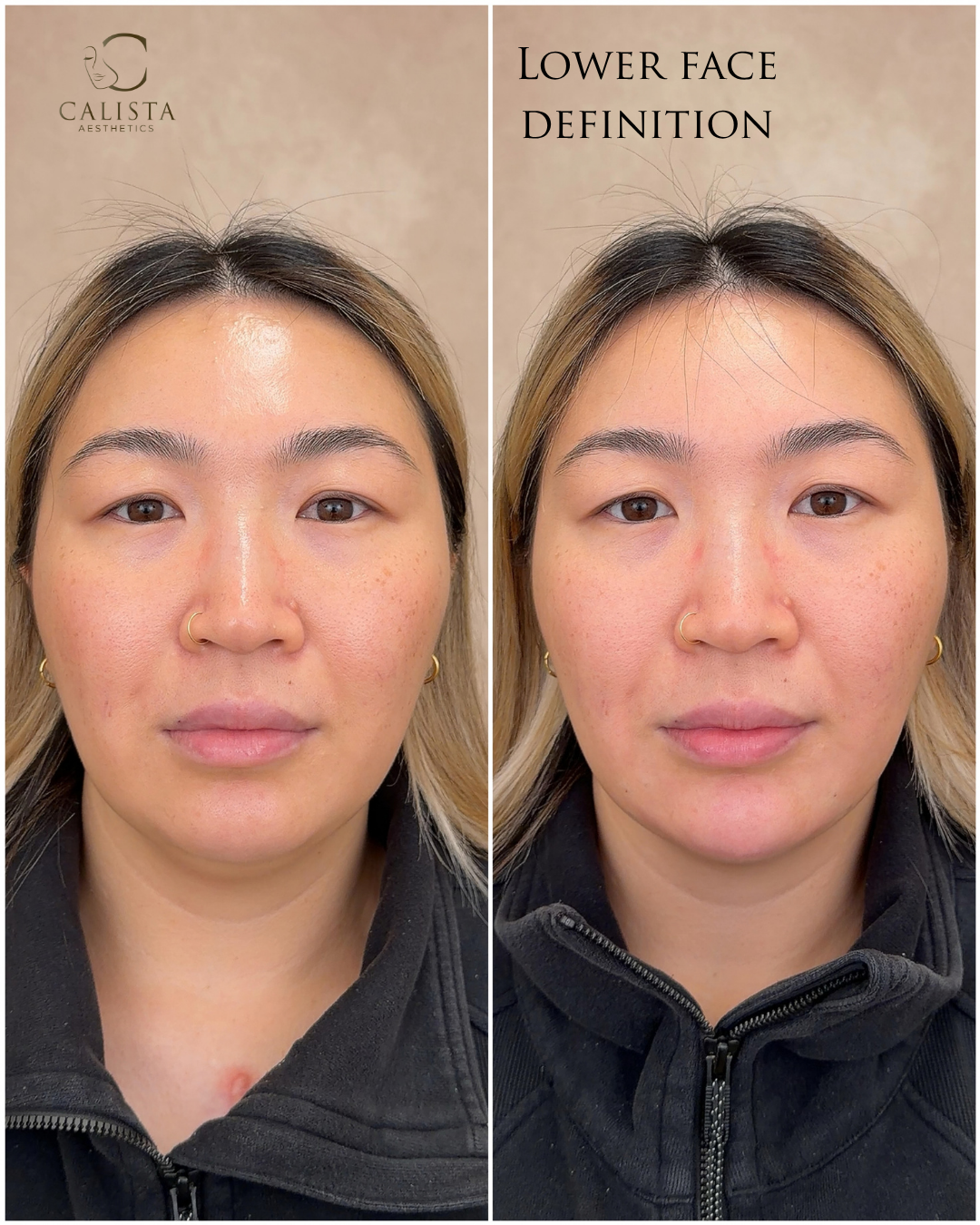
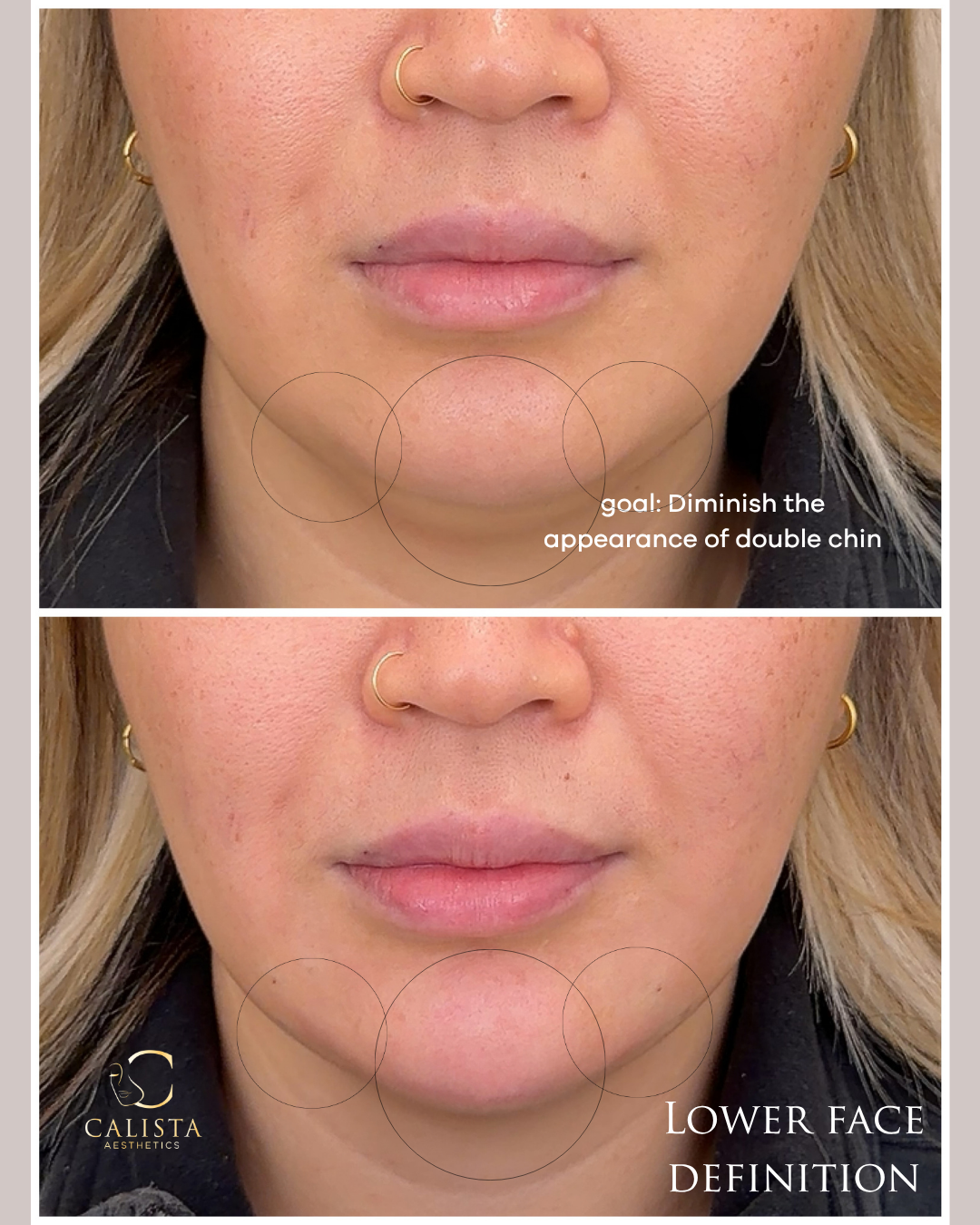
The September 30 carousel, shared by Calista and Catherine Ngo, nurse practitioner, presents three paired views: a front-facing comparison, a closer lower-face comparison with circles and a goal annotation, and an angled comparison. The graphics identify the subject as lower-face definition. The accompanying source describes treatment of the chin and chin shadows.
Those details give the case a specific focus: the relationship between the central chin and the contours beside it. They do not establish a complete injection record. A photograph and a treatment-area label cannot identify the filler material, brand, amount or number of visits.
The incomplete-plan qualification matters just as much as the treatment description. These images should be understood as a selected comparison within the source’s account, rather than a finished lower-face transformation. They cannot establish what remained in the plan or how the eventual outcome developed.
The narrow lesson is about interpreting an appearance goal honestly. This case does not demonstrate that filler eliminates a double chin, replaces surgery or gives another person the same result.
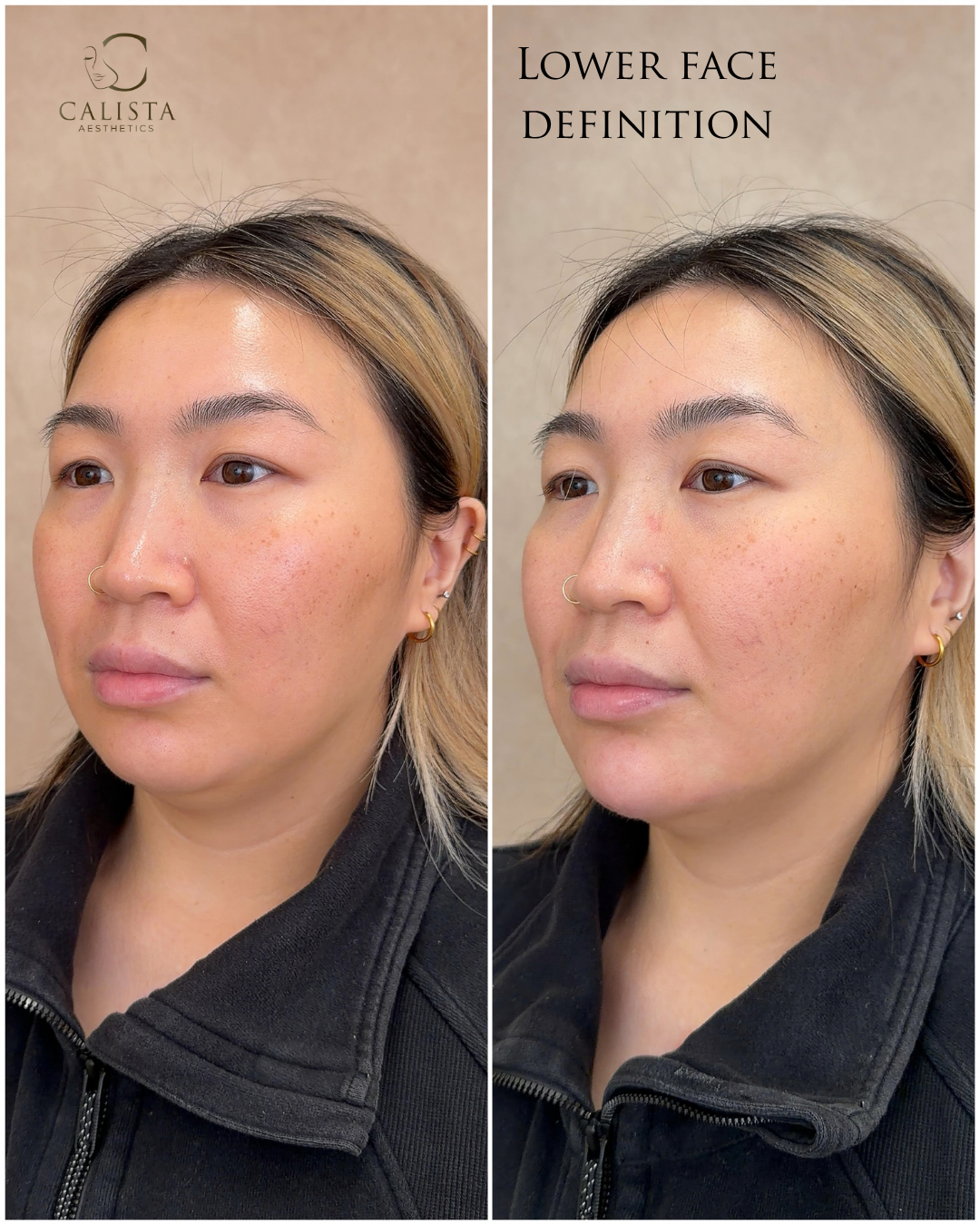
The front-facing view lets you compare the visible outline and proportions of the lower face. The angled view offers another perspective on the chin and the transition toward the neck. Looking at both is more informative than treating one flattering angle as the entire result.
The closer graphic adds circles around the chin and adjacent areas. Its annotation describes a goal of diminishing the appearance of a double chin. A treatment goal is not a measurement of an achieved result. The circles also should not be read as an injection map, a dose guide or evidence that fat was removed from the marked areas.
When looking at any comparison, consider whether the head position, expression, lighting, framing and camera angle are comparable. Those are questions about how much the photographs can tell you. They are not a diagnosis of the person pictured or an allegation that an image was altered.
These selected views provide visual context. They do not supply a standardized measurement of skin laxity, a fat-volume assessment or evidence of long-term persistence. They also cannot establish how much of the appearance is attributable to one treatment when the full plan is not documented here.
Calista uses chin filler and chin shadow as distinct service terms. In this case, the source refers to the chin and the adjacent shadow areas while discussing lower-face transitions.
“Chin shadow” is an area description in that account, not the name of an injectable product. It does not mean that every shadow should be filled or that a shadow proves a volume deficit. A clinician needs to explain what they are assessing, why a particular area is relevant and what change is realistic.
The question “Which injections were used?” therefore deserves a specific answer during consultation. Ask for the exact product name and the reason for selecting it for the proposed location. A general chin-filler guide or a familiar brand elsewhere on a clinic website does not identify what was used in this comparison.
FDA approval is also specific to products and uses. The FDA’s approved filler information is a starting point for checking a named product; it is not blanket approval for every product or placement described as chin treatment.
You do not need to arrive knowing which injection to request. It is more helpful to describe what bothers you: the projection of the chin, the outline from an angle, fullness underneath, loose skin, or uncertainty about the difference.
Ask the clinician which parts of that concern filler could address and which parts it would leave unchanged. If adding volume does not address your goal, the consultation should make that limitation clear. Discussing other options, referral or choosing no treatment can be part of an appropriate assessment; this article does not establish that Calista offers a fat-removal or surgical procedure.
For a staged plan, ask what the first step is intended to accomplish and how the decision about another step will be made. A staged approach should not become a promise that every concern will eventually be corrected with filler.
Bringing a reference photograph can help explain your preference. It cannot establish that your anatomy, treatment needs or likely result match the person in the image.
A comparison photograph cannot set your recovery schedule. Before treatment, ask what reactions are possible with the proposed product, what written aftercare you will receive and when the clinician wants to reassess the result.
Keep early appearance, a later clinical assessment and longer-term follow-up as separate questions. A selected image does not answer all three. In this case, the source’s incomplete-plan statement is a further reason to avoid treating the photographs as evidence of a final or lasting outcome.
Calista’s dermal filler aftercare guide provides a place to review existing guidance. Your treating clinician should explain the instructions relevant to the actual product and procedure, including whom to contact if recovery is not following the expected course. Do not use this case as a maintenance calendar or assume that another person’s photographed appearance predicts your follow-up needs.
Dermal filler is a medical procedure. Common reactions include swelling, bruising, tenderness and redness; other complications can include infection and nodules. Accidental injection into a blood vessel can cause serious harm, including tissue death, blindness or stroke. Removing filler may require additional procedures and can be difficult or impossible. FDA: Dermal Filler Do’s and Don’ts
Ask about the injector’s qualifications and experience, the proposed product’s patient labeling, your relevant medical history and the plan for recognizing and managing complications. A reassuring comparison image does not replace that discussion.
Seek immediate medical attention for unusual pain, vision changes, white, gray or blue skin near the injection site, or signs of stroke during or shortly after treatment. These are warning signs described in the FDA’s patient guidance, not routine changes to wait out at home.
For this concern, the most useful consultation questions are:
Calista Aesthetics is at 201 Sandpointe Ave, Suite 135, Santa Ana, CA 92707. Review consultation information and the Booking Policy before scheduling. You can book a consultation to discuss your own goals and whether treatment is appropriate.
For separate questions, the journal’s chin results guide and chin cost guide address those subjects in more depth. This case’s central distinction remains the one to bring into the room: changing the appearance of contour does not mean removing fat or loose skin.